
Why Your Restaurant P&L Says You Made Money — and Your Bank Account Disagrees
Why Your Restaurant P&L Says You Made Money — and Your Bank Account Disagrees
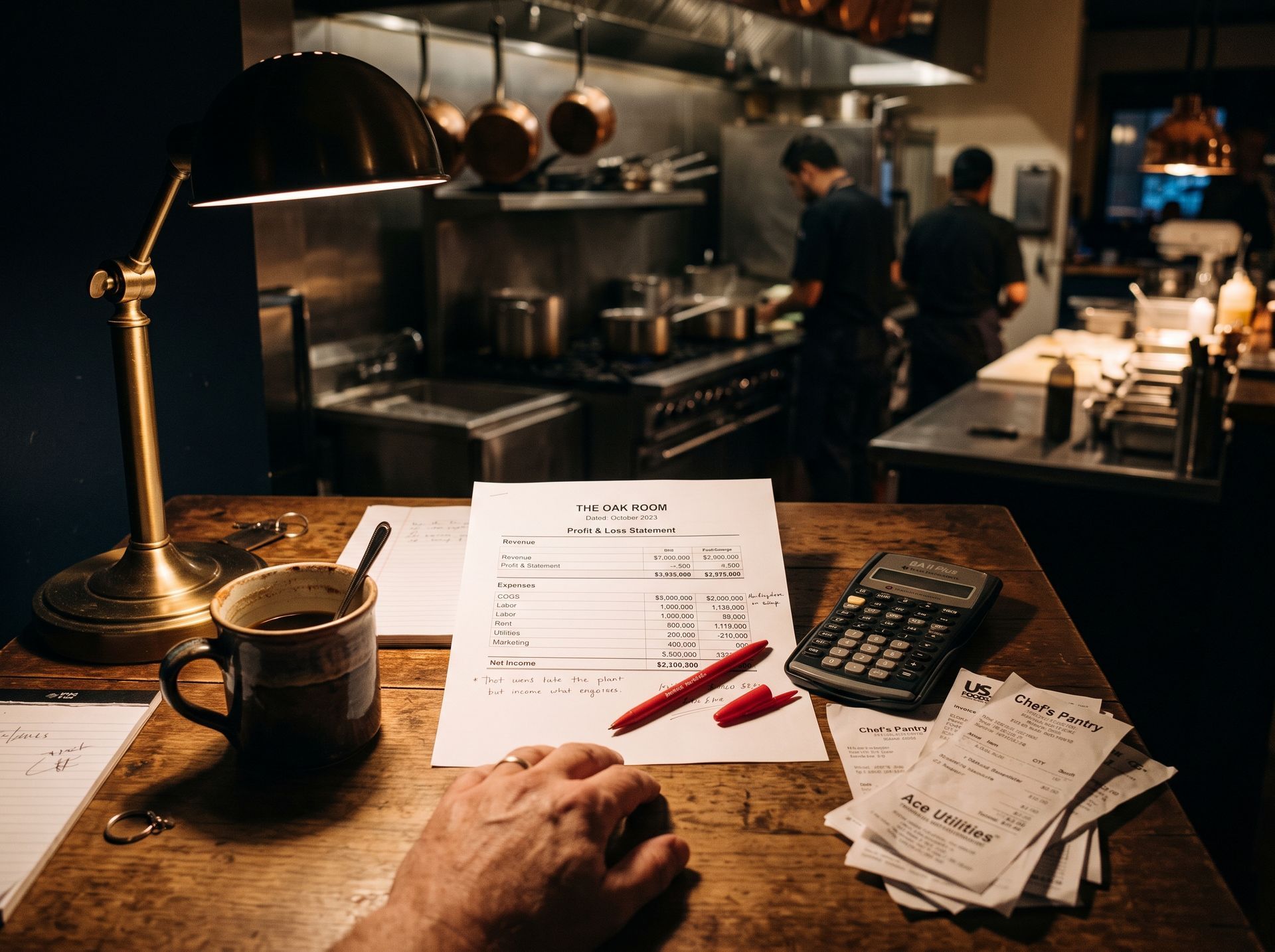
Your restaurant can show a profit on paper and still feel broke.
Here’s why — and what restaurant owners should be watching besides the P&L.
You had a good month.
Sales were solid. Labor was under control. Food costs weren't terrible. Your accountant sends over the Profit & Loss statement and there it is: The restaurant made money. Great.
Then you open your bank account.
And your first thought is: Where did the money go?
If you've ever experienced this, you're not alone — and it doesn't necessarily mean your P&L is wrong.
The problem is much simpler:
Profit and cash are not the same thing.
Understanding the difference can be one of the most important financial lessons for a restaurant owner.
Your P&L Tells You One Part of the Story
Your Profit & Loss statement is designed to answer an important question:
Did my restaurant generate a profit during this period?
At a basic level, it looks something like this:
Sales – Expenses = Profit
For example:
Restaurant sales: $100,000
Operating expenses: $90,000
Profit: $10,000
You made $10,000.
So there should be another $10,000 sitting in the bank, right?
Not necessarily.
Your bank account answers a different question:
How much cash do I actually have available right now?
Those two numbers can be very different.
The Restaurant Cash Flow Problem
Imagine your restaurant reports a $10,000 profit.
But during that same period, cash also went toward things such as:
- Sales tax payments
- Loan principal
- Equipment purchases
- Previous bills coming due
- Owner distributions
- Credit card payments
- Other cash obligations
Some of those transactions may affect your bank balance differently than they appear on your P&L.
That's how a restaurant can technically be profitable while the owner is wondering why there isn't enough money in the bank.
Profit measures performance.
Cash flow measures movement.
And you need both.
Cash Trap #1: Sales Tax Looks Like Your Money
This is one of the easiest restaurant cash-flow mistakes to make.
A customer buys $100 worth of food.
Let's say another $8 is collected for sales tax.
The restaurant receives: $108
You see $108 coming into the business.
But all $108 isn't yours.
The sales tax portion will eventually need to be remitted to the appropriate taxing authority.
That creates a dangerous illusion.
Your bank account may look healthier than it actually is because some of the money sitting there is already spoken for.
And restaurants have expenses coming at them constantly:
- Payroll
- Food vendors
- Rent
- Utilities
- Insurance
- Repairs
- Marketing
- Software
- Credit cards
When cash gets tight, it becomes very easy to mentally treat the entire bank balance as available operating cash. It isn't.
Sales tax collected should not be confused with money available to operate your restaurant.
Cash Trap #2: Timing Can Make a Profitable Restaurant Feel Broke
Restaurants have money moving in and out constantly.
The problem is that it doesn't always happen at the same time.
Imagine you have a strong weekend.
Your POS reports thousands of dollars in sales.
But meanwhile:
- Payroll clears.
- Your food distributor gets paid.
- Rent is due.
- A credit card payment hits.
- An equipment repair comes out of the account.
The restaurant may have generated profitable sales, but your timing of cash coming in versus cash going out creates pressure. That's cash flow. And when the cash cushion is small, timing becomes extremely important.
Restaurants Don't Have Much Room for Error
This is where the numbers become important.
Research from the JPMorgan Chase Institute examining hundreds of thousands of small businesses found that the median small business held 27 days of cash reserves.
Restaurants were much tighter.
The median restaurant had only 16 cash buffer days.
Think about what that means.
A cash buffer represents roughly how long a business could continue covering its normal cash outflows if money suddenly stopped coming in.
For restaurants, the median was just over two weeks.
That's not much room.
One unexpected equipment failure.
One slow month.
A large tax payment.
Food costs increase.
Overtime gets out of control.
A walk-in refrigerator dies.
Several things hit at once.
Suddenly, what looked like a profitable restaurant can have a very real cash problem.
Cash Trap #3: Debt Payments Can Fool You
Here's another area that causes confusion.
Suppose your restaurant has a business loan.
Every month, $3,000 leaves your bank account.
But accounting doesn't necessarily treat that entire $3,000 as an expense on your P&L.
Part may be interest.
Part may be repayment of the loan principal.
Your bank account doesn't care about that distinction.
The entire $3,000 still left your account.
That's another reason an owner can look at the P&L and think:
“It says we made money. Why don't I have it?”
Some cash leaving the business doesn't appear as a normal operating expense on the P&L.
Cash Trap #4: Buying Equipment Uses Real Cash
Your refrigerator dies.
You spend $8,000 replacing it.
Your bank account immediately knows what happened:
-$8,000
But accounting rules may spread the expense of certain equipment purchases over several years through depreciation rather than showing the entire purchase as an immediate expense on the P&L.
Again:
Your P&L and your bank account are measuring different things.
The P&L may still show a profitable restaurant.
Your checking account just lost $8,000.
Both numbers can be correct.
Cash Trap #5: Yesterday's Bills Get Paid With Today's Money
Restaurants also have expenses that cross reporting periods.
A food order may arrive near the end of one month but get paid the following month.
A credit card balance may contain expenses from previous weeks.
Taxes accumulate before they're paid.
Invoices have different payment terms.
That means some of the cash leaving your account today may relate to expenses incurred earlier.
This is why looking at your bank balance alone doesn't tell you whether your restaurant is profitable.
And looking only at your P&L doesn't tell you how much cash is available.
A Simple Example
Let's keep this simple.
Suppose your restaurant reports:
Sales: $100,000
Operating Expenses: $90,000
Operating Profit: $10,000
You might expect your cash to increase by $10,000.
But then other cash obligations hit:
Sales tax payment: -$4,000
Loan principal: -$2,000
Equipment purchase: -$2,500
Other cash obligations: -$1,000
Now your bank account only increased by:
$500
The restaurant made money.
But very little additional cash remained.
That's the difference.
One Simple Way to Protect Your Sales Tax Money
One practical way to reduce cash-flow surprises is to stop allowing sales tax money to mix with money you mentally consider available for operating the restaurant.
Some restaurants accomplish this by maintaining a separate account and regularly moving the appropriate sales tax into it.
There are also automated services that handle this process.
For example, DAVO by Avalara integrates with supported POS systems and uses the restaurant's sales data to calculate the sales tax collected. The service sets that money aside daily in a separate tax holding account and then files and pays the sales tax when it's due.
The basic idea is simple:
If the tax money isn't sitting in your operating account, you're less likely to accidentally treat it as operating cash.
Automation isn't required to follow this principle.
The important lesson is to have a system that separates money you own from money you've collected but will eventually owe.
Four Numbers Restaurant Owners Should Watch Every Week
You don't need to become an accountant.
But you should understand the financial condition of your restaurant.
Start by knowing these four numbers:
1. Current Available Cash
How much money is actually available to operate the restaurant?
Not tomorrow's expected deposits.
Not your credit line.
Cash available today.
2. Money Already Spoken For
How much of your current balance belongs to upcoming obligations?
Think about:
- Sales tax
- Payroll
- Rent
- Vendor payments
- Debt payments
- Credit cards
Your checking account balance and your available operating cash aren't necessarily the same number.
3. Your Weekly Cash Burn
Roughly how much money does your restaurant need each week to operate?
Knowing this helps you understand your cash buffer.
If you have $30,000 of truly available cash and typically need $10,000 each week to operate, you have roughly three weeks of protection.
That's a much more useful number than simply saying:
“We have $30,000 in the bank.”
4. Your Actual Profit
You still need the P&L.
Cash flow doesn't replace profitability.
A restaurant that continually loses money can't solve the problem simply by managing its bank account better.
The goal is to understand both:
Is the restaurant profitable?
and Is the restaurant generating and protecting enough cash?
Profit Doesn't Pay Tomorrow's Bills. Cash Does.
Restaurant owners spend enormous amounts of time watching sales.
That's understandable.
Sales are visible.
Your POS shows them every day.
But sales alone don't tell you whether the restaurant is healthy.
Neither does your bank balance.
And neither does your P&L by itself.
A financially healthy restaurant needs three things working together:
- Sales
- Profit
- Cash Flow
Sales tell you how much business you're doing.
Profit tells you whether there's money left after operating the business.
Cash flow tells you whether the money is available when you actually need it.
That's why a restaurant owner can have a profitable month and still feel cash-strapped.
Nothing mysterious happened to the money.
You were simply looking at two different measurements.
The P&L tells you whether your restaurant made money.
The bank account tells you how much cash you have today.
And understanding the difference can help you make much better decisions about your restaurant.
One Question to Ask This Week
Before looking at your next bank balance and deciding how much money your restaurant has available, ask yourself:
“How much of this money is actually mine to spend?”
Then subtract the money already committed to taxes, payroll, vendors, debt and other upcoming obligations.
That number may give you a much clearer picture of the financial health of your restaurant.
Because in the restaurant business, profitability matters — but protecting your cash keeps the doors open.
Educational note: This article provides general business information and is not accounting, tax, or financial advice. Restaurant owners should work with their accountant, bookkeeper, or tax professional regarding their specific business.
Disclosure: Local Restaurant Owner / Bring More Clients may receive referral compensation if you choose to use certain services discussed on this site, including DAVO. Recommendations are based on their potential usefulness to restaurant operators.
Insights