
What Does Your Restaurant POS and Payment Stack Really Cost Today?
What Does Your POS and Payment Stack Cost Today — and How Has That Changed Since You Signed Up?

Restaurant owners spend a lot of time watching food cost, labor and sales.
But there is another number worth reviewing:
What does your entire POS and payment stack cost you today — and how has that changed since you originally signed up?
That question is becoming more important as restaurant technology companies continue changing how software, devices and payment processing are priced.
Toast provides two recent examples.
This isn't about whether Toast is a good or bad POS system.
It's about understanding how the cost of a restaurant's technology can change over time — and why owners should occasionally rebuild the math from the ground up.
Toast Is Tightening the Connection Between Devices and Software Subscriptions
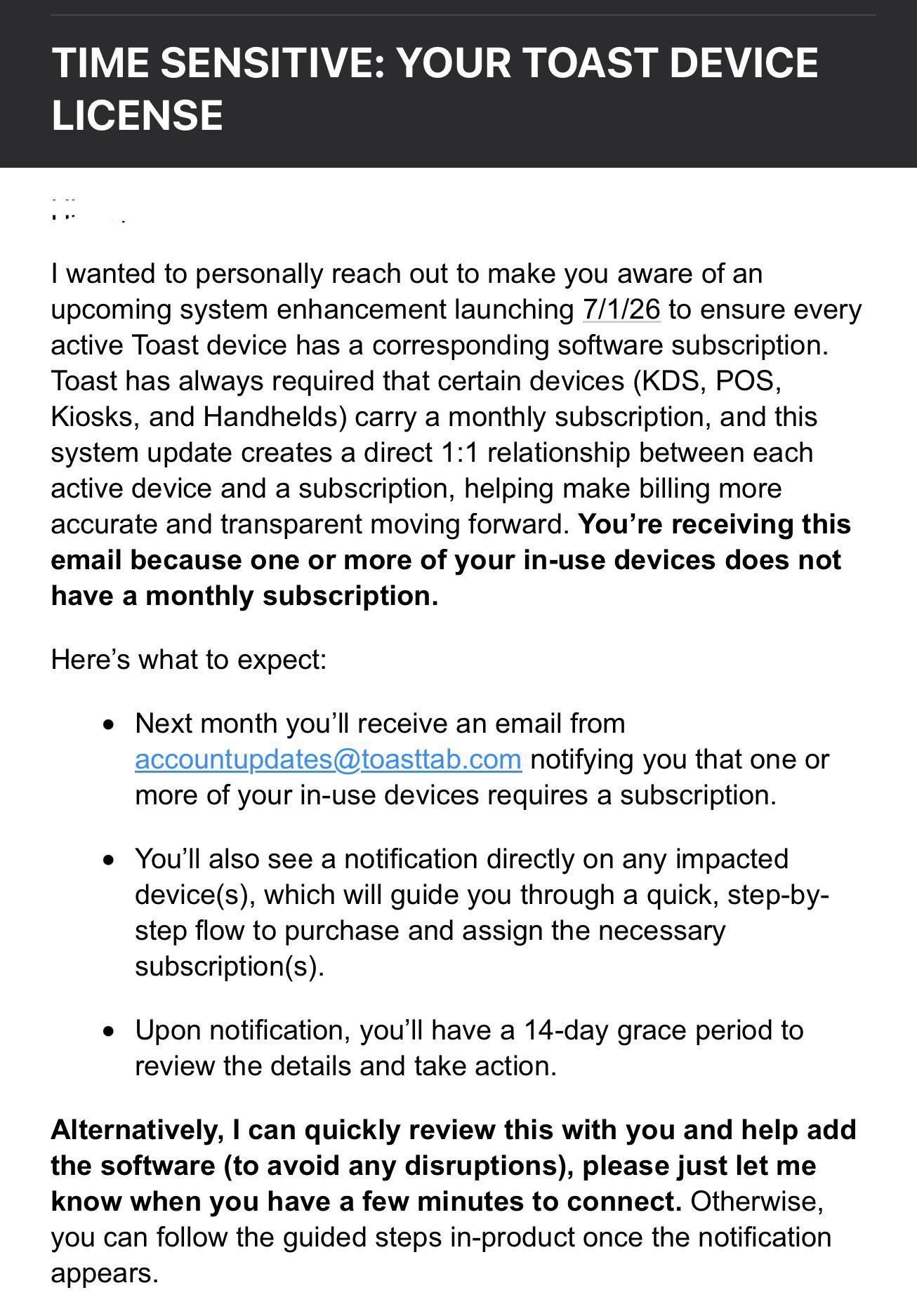
Toast has introduced what it calls Device Licensing.
Toast describes the system as making sure every Toast device using its software has a matching active subscription.
According to Toast:
“Each hardware device running Toast software needs a matching software subscription to stay active.”
Toast says Device Licensing is currently in limited release with select customers.
The company explains that a restaurant may see a licensing notice even if its number of devices hasn't changed. This can happen when a device was replaced, moved between locations, purchased secondhand, or when a subscription was previously removed or changed.
Toast also says it is not billing retroactively for previous unlicensed device usage.
Once an affected restaurant is notified that a device does not have an active subscription, Toast says the restaurant has 14 days to take action before that device becomes locked.
Toast's Merchant Agreement also states that, where applicable, merchants must maintain active software subscriptions for their hardware devices.
Source:
Toast — Device Licensing FAQ
LINK TO TOAST DEVICE LICENSING FAQ
Source:
Toast — Merchant Agreement, Section 4.10
LINK TO TOAST MERCHANT AGREEMENT
Why should a restaurant owner care?
Because the number of devices inside a restaurant can affect the restaurant's recurring technology cost.
A restaurant may have:
- POS terminals
- Handhelds
- Kitchen Display Systems
- Self-ordering kiosks
- Additional tablets
Toast's support documentation explains that these device categories can carry their own subscription line items.
That means an owner shouldn't look only at the price of the physical hardware.
The better question is:
What is the ongoing software cost connected to every active device in my restaurant?
Toast Has Also Announced Changes to Card-Processing Rates
Device subscriptions are only one part of the equation.
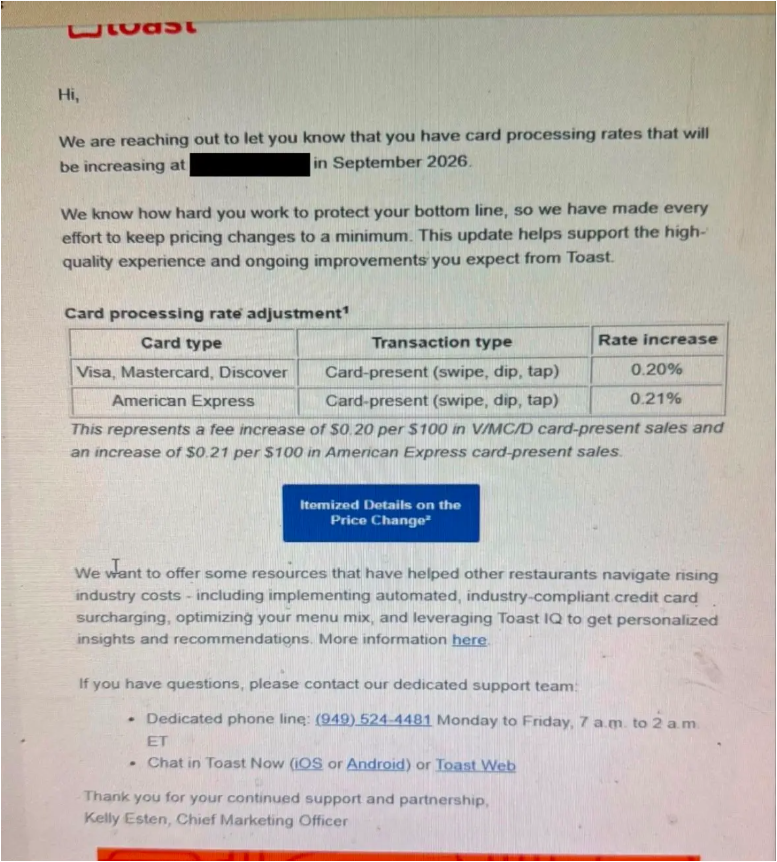
Toast has also communicated increases to certain card-present processing rates scheduled for September 2026.
A merchant communication reported increases of:
- 0.20 percentage points for Visa, Mastercard and Discover card-present transactions.
- 0.21 percentage points for American Express card-present transactions.
Those numbers may look small when viewed as percentages.
But processing costs are tied to transaction volume.
For example, an additional 0.20 percentage points equals approximately $200 for every $100,000 of applicable processing volume, before considering the merchant's particular card mix, pricing arrangement or other account-specific factors. [ Toast Rate Increase September 2026 link ]
At $1 million of applicable volume, that same mathematical difference would equal approximately $2,000.
That is not an estimate of what any particular Toast restaurant will pay. It simply demonstrates why small percentage changes deserve to be converted into actual dollars.
Source:
Reforming Retail — “Another Toast Rate Increase, And A Merchant’s Way Out”
LINK TO REFORMING RETAIL ARTICLE
Restaurant owners should review their own Toast communication and agreement to determine whether a change applies to their particular account.
The Agreement Matters Too
There is another reason owners should read these notices rather than simply looking at the new price.
Toast's current Merchant Agreement addresses certain changes to software fees and card-processing rates.
Section 6.2 states that Toast may change certain card-processing rates and non-software fees with 30 days' prior written notice.
The same section also describes actions a merchant may take if the merchant does not accept certain changes, including specific written-notice requirements.
The exact language matters.
A restaurant owner should not assume that every price increase automatically creates a right to cancel, remove a service or avoid a fee.
The type of fee, the merchant's agreement, the effective date and the required notice can all matter.
Source:
Toast — Merchant Agreement, Section 6.2
[LINK TO TOAST MERCHANT AGREEMENT]
This Is Bigger Than One Toast Announcement
The important lesson isn't simply:
Toast changed a fee.
Restaurant technology has become a stack of interconnected costs.
A restaurant may be paying for:
- POS software
- Payment processing
- POS terminals
- Handheld subscriptions
- Kitchen display subscriptions
- Online ordering
- Loyalty
- Marketing tools
- Payroll or team-management services
- Third-party integrations
- Delivery-related technology
- Other optional modules
Some costs are fixed monthly expenses.
Others increase with the number of devices.
Others change with credit-card volume.
And some services that were originally discounted, bundled or promotional may look different several years later.
This makes the original sales proposal only one part of the story.
Don't Compare Today's POS Against Yesterday's Quote
When restaurant owners consider another POS system, there is a common comparison:
What am I paying now versus what the new company is quoting me?
But even that comparison can be incomplete.
First establish what the current system actually costs today.
Look at the last several months of:
- POS software invoices.
- Credit-card processing statements.
- Device subscriptions.
- Add-on software and services.
- Online ordering and delivery-related expenses.
- Third-party integrations.
- Annual or periodic charges.
Then convert those costs into a monthly and annual number.
Only then do you have a meaningful baseline.
The Question I Would Ask
If you have been using the same restaurant technology for several years, don't rely on what you remember agreeing to when you signed up.
Ask:
What does my entire POS and payment stack cost me today — and how has that changed since I signed up?
That number can tell you much more than the advertised monthly price of your POS.
And before replacing anything, understand the system you already have.
Sometimes the opportunity isn't immediately switching systems.
Sometimes it starts with finally knowing what the current one actually costs.
Insights